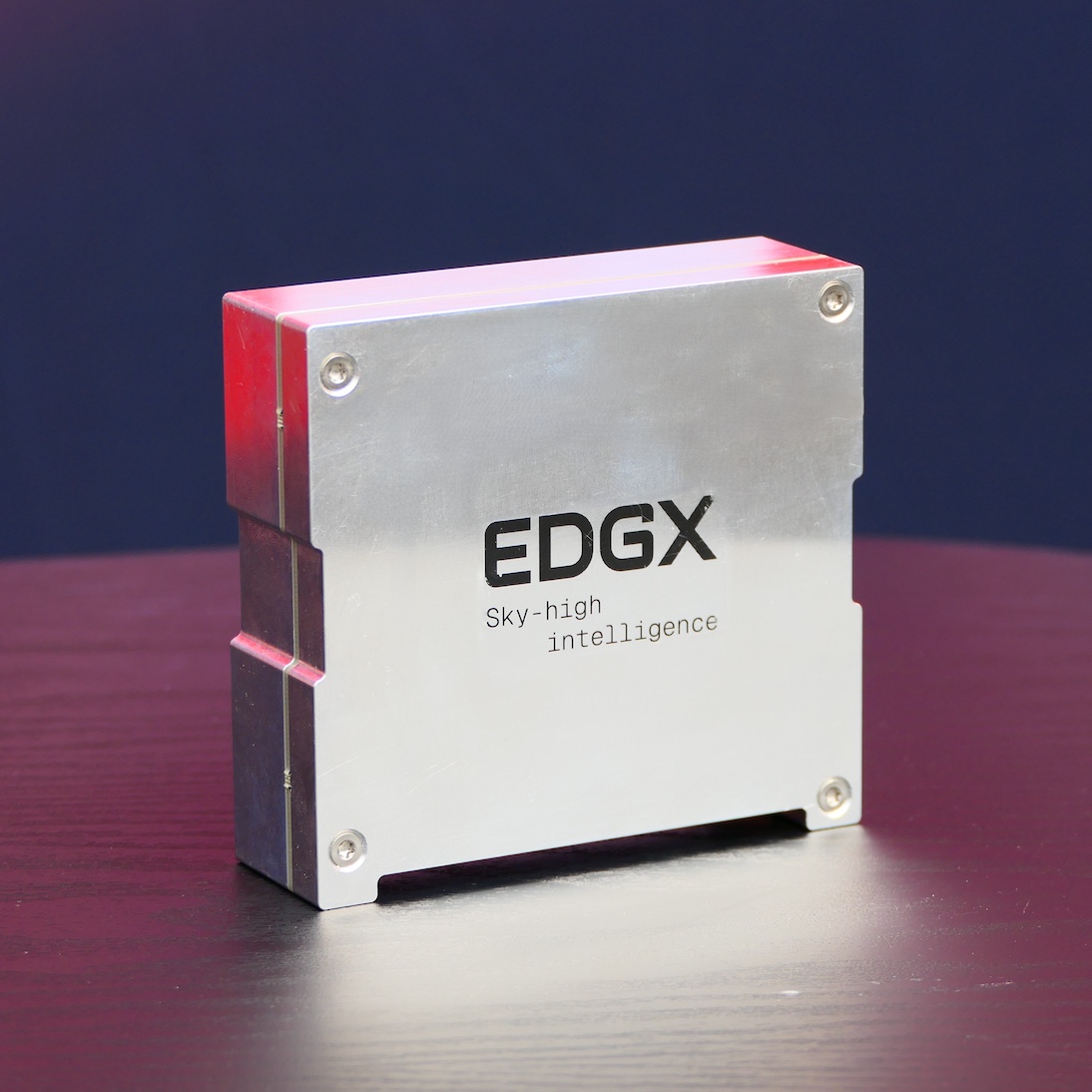


A launch takes only a few minutes, but for everything on board, those minutes are the roughest of the whole mission. First there is the shaking of the climb, then a few sharp knocks when parts of the rocket separate and the satellite is released. Once Sterna, our onboard satellite computer, is in orbit, it will never be shaken that hard again.
This first post in our testing series covers the two launch tests: vibration, which we now run in our own lab in Ghent, and shock.
What a launch does to a computer
A rocket shakes everything it carries. The engines and the air rushing past the nose cone push energy into the structure, and that energy travels through the satellite into every bracket, board and screw.
Three things can go wrong. A single hard push can bend or break a part. Minutes of constant shaking can wear out a joint, like a paperclip bending back and forth until it breaks. And every structure has frequencies it likes to move at. If the rocket shakes at one of those, the motion builds up. Engineers call that a resonance.
Then come the knocks. Every time a stage drops off or the nose cone opens, a release mechanism fires: explosive bolts on some rockets, pneumatic pushers on others. And then there is the satellite’s own release, right at its mounting point. That one is usually the hardest. Each one lasts a few thousandths of a second. It barely moves the satellite, but small, stiff parts feel it hard: solder joints, small components, connectors.
Vibration in our own lab
Since April 2026, we have an electrodynamic shaker in the lab. It works like a big, very precise loudspeaker: an electric coil sits in a strong magnetic field and drives a table. It pushes with up to 15 kilonewtons, about the weight of a 1.5-tonne car.
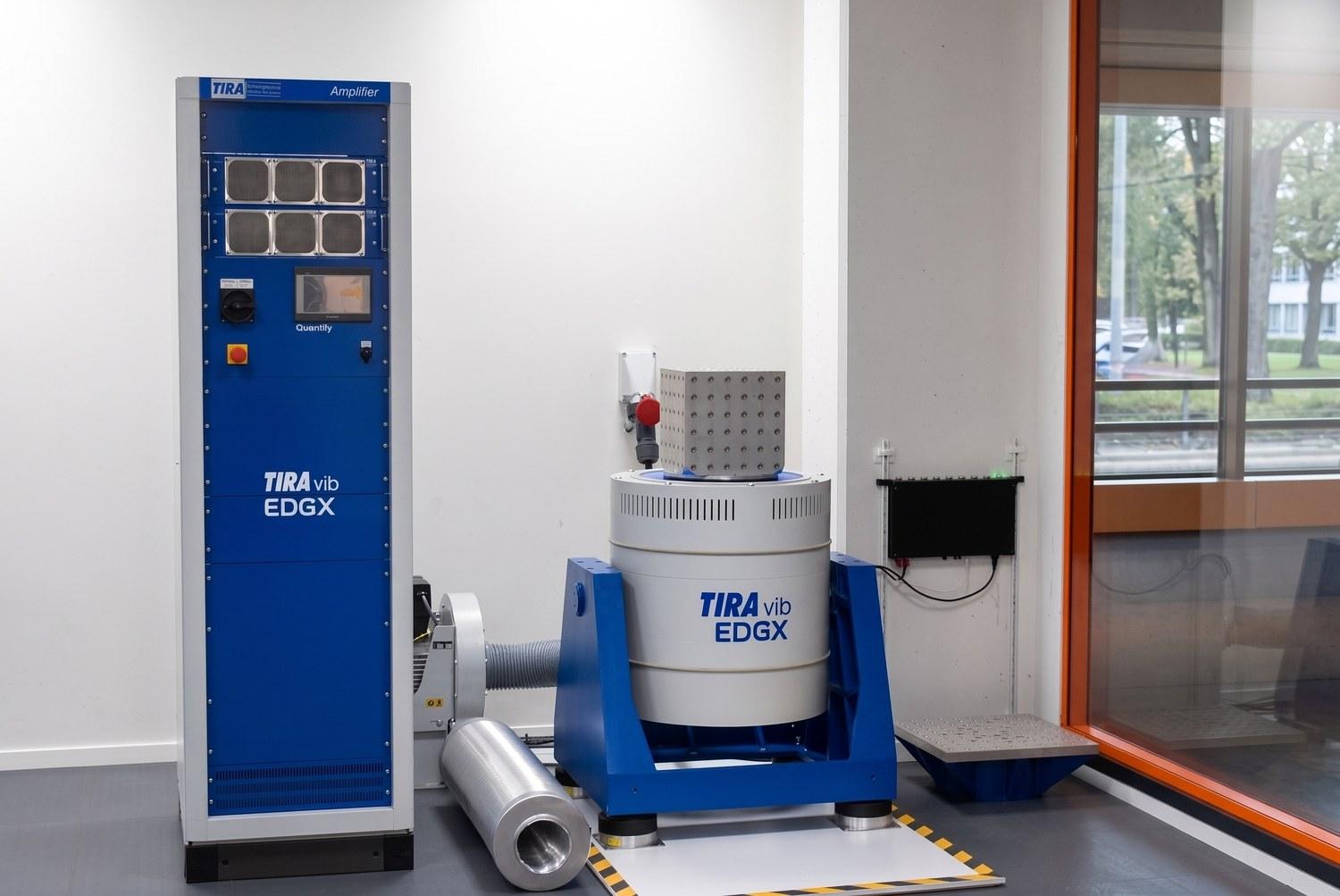
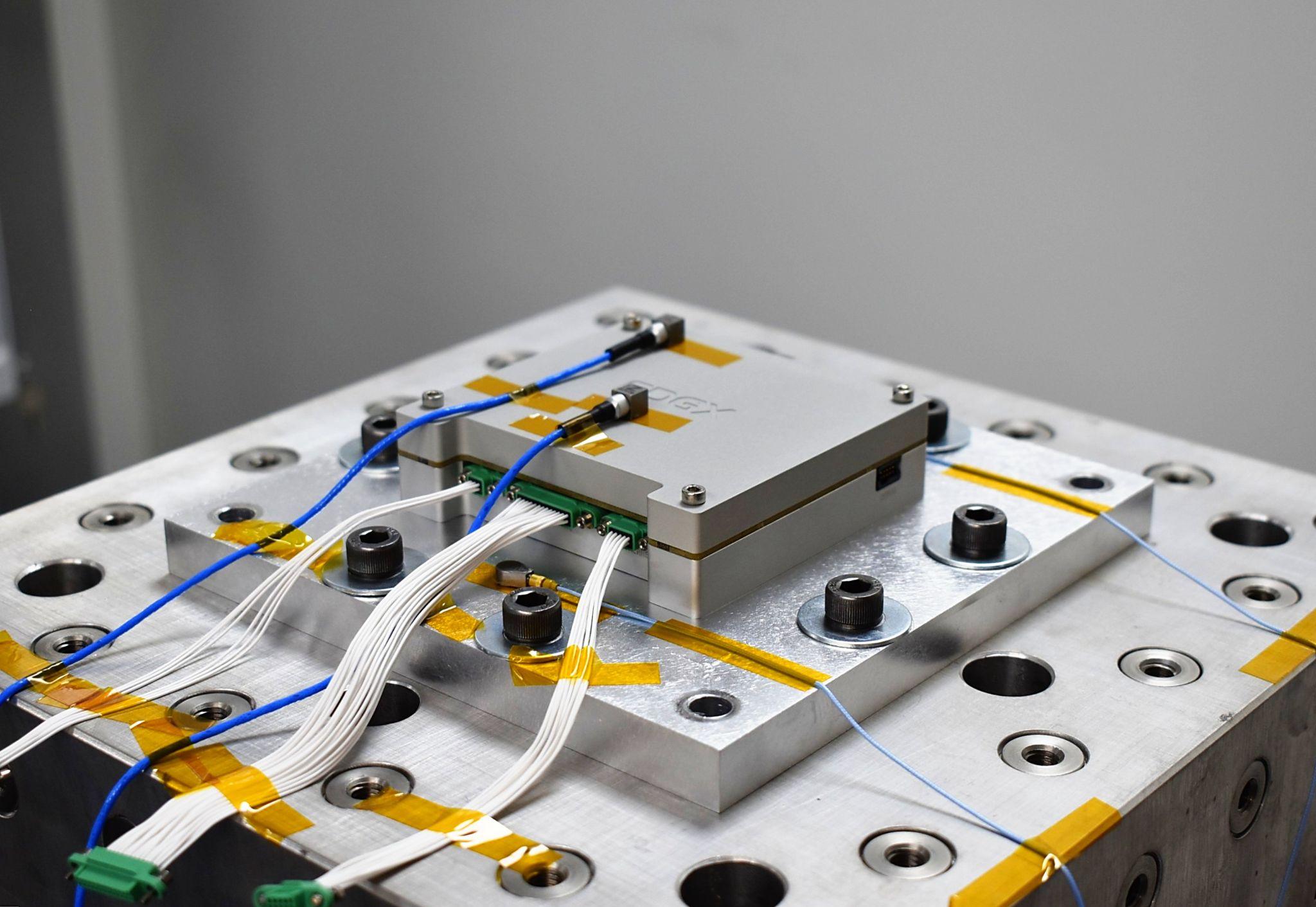
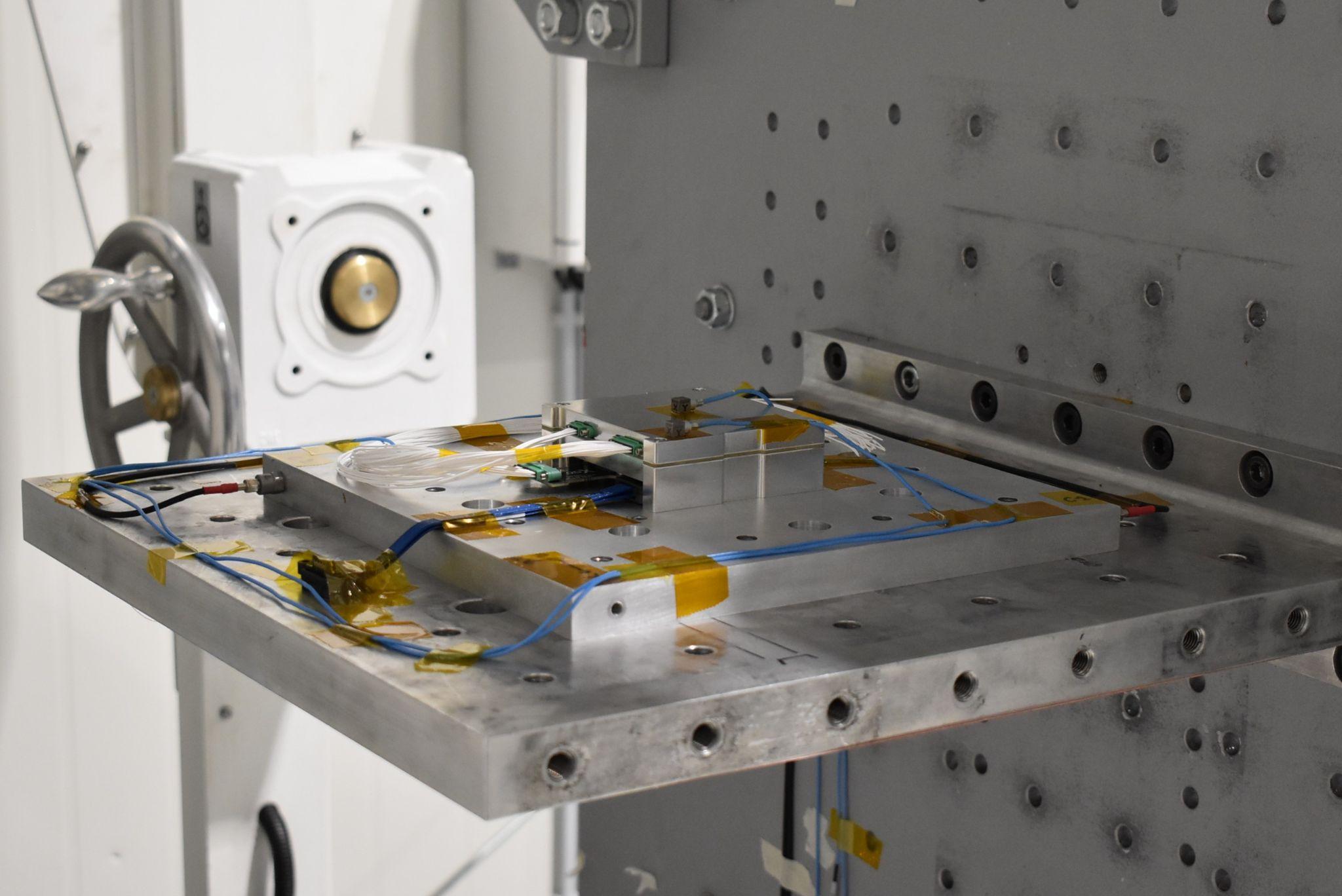
Sterna is bolted to a thick plate on top of a 36 kg metal cube. The shaker table only moves up and down, so with the plate on top of the cube, Sterna is shaken vertically. For the two sideways directions, the plate goes on a side face of the cube instead. Sensors on the plate steer the shaker, and sensors on Sterna record its response.
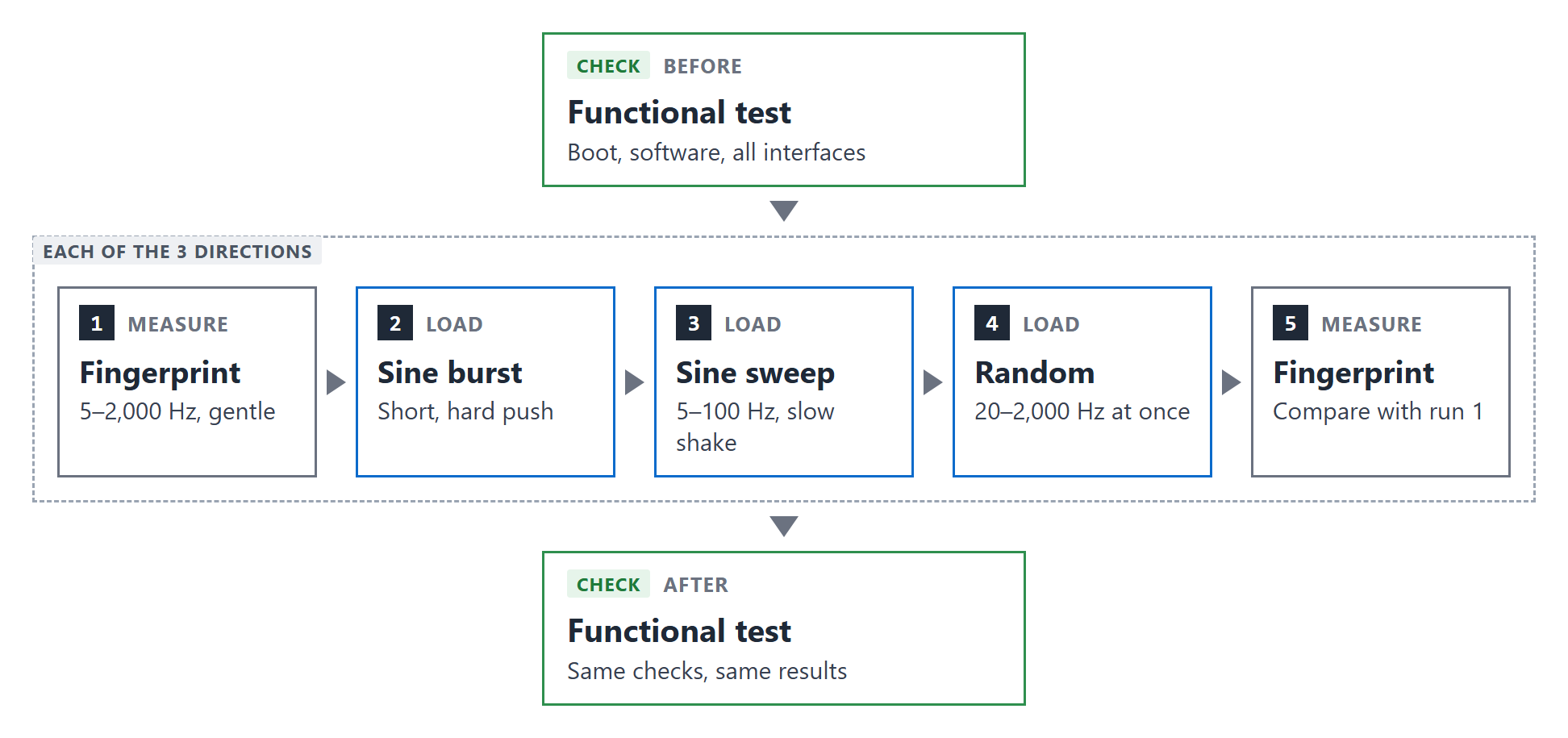
Each direction gets the same five runs:
- Fingerprint. A gentle tone that slowly rises from 5 to 2,000 hertz (Hz, vibrations per second). It shows at which frequencies Sterna resonates and becomes our reference.
- Sine burst. A short, hard push at a single low frequency. It mimics the heaviest steady loads of the climb.
- Sine sweep. A slow shake from 5 to 100 Hz, for the rocket’s big, rolling motions.
- Random vibration. Two minutes of shaking with every frequency from 20 to 2,000 Hz mixed together, like the roar of the engines. This run tests fatigue.
- Fingerprint again. If anything cracked, came loose or shifted, its resonances move.
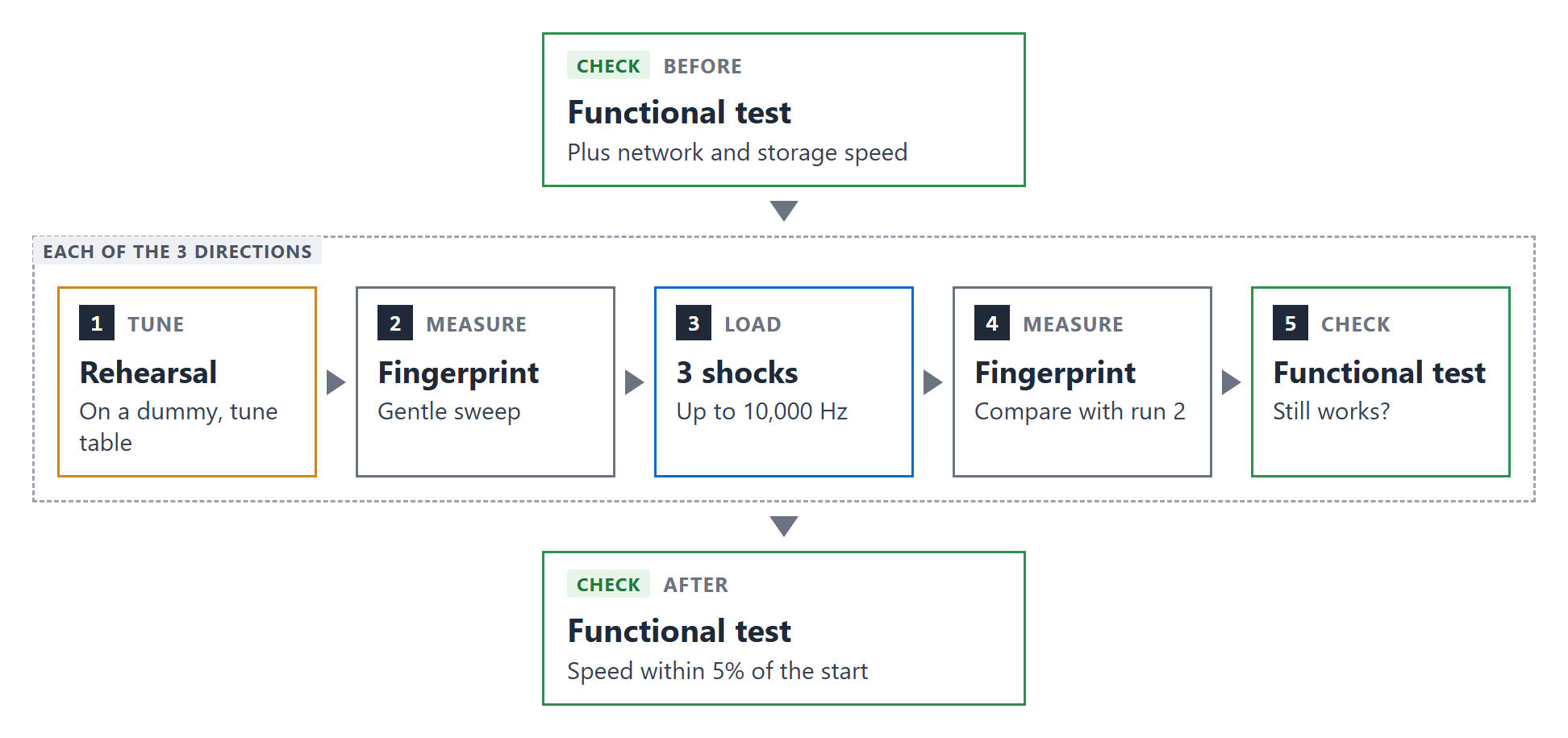
Before the first run and after the last, Sterna gets its full functional test: it boots, runs its software, and we check its interfaces, memory, storage and processing.
Having the shaker in-house changed how we work. Before April, every test meant booking days at an external lab and driving the unit there. Now we rehearse on a prototype first, and a complete campaign in all three directions fits in a single day. When someone wants to know how a new bracket or board behaves, we bolt it on and find out.
Shock at V2i
A shaker can’t produce a separation shock. That takes a shock table, which is really a very accurate air gun: it fires a metal slug at a heavy plate, and the plate rings with Sterna bolted to it. Think of a fancy potato gun. The lab shapes the shock by changing the air pressure and the material between the slug and the plate it hits. This is one test we don’t run in-house: we go to V2i, a test lab in Liège.
Sterna has to be ready for more than one rocket. So we took the shock levels two launchers publish for the satellite’s mounting point, added a safety margin to each, and drew one target curve above both. That curve is called a shock response spectrum (SRS): for each frequency, it shows how hard a small part that naturally vibrates at that frequency would be thrown around.
You can’t simply dial that curve in. The lab first fires at a dummy with the same mass and adjusts between shots until the measured curve sits on or just above the target. Then it is Sterna’s turn: a fingerprint sweep on the shaker, three shocks in each of its three directions, and the fingerprint again.
How we know it passed
Both tests end with the same three questions.
- Is it stiff enough? Sterna’s lowest resonance has to sit well above the low frequencies of the rocket’s big motions, so there is nothing to amplify.
- Did anything change inside? We lay the fingerprints from before and after on top of each other. A resonance may shift at most 5% in frequency and 20% in height.
- Does it still work? The full functional test has to pass before and after, with the same results.

If all three check out, the unit is ready for its next step: thermal vacuum testing, which we also run in our own lab. That is the next post in this series.